

Eridonia Archives
(Wheeled AFV)(UTN) AFV-6 IFV/APC
A medium-weight wheeled Armoured Fighting Vehicle developed and used by the UTN (Old Federation) Planetary Forces as an APC or IFV, depending on configuration.
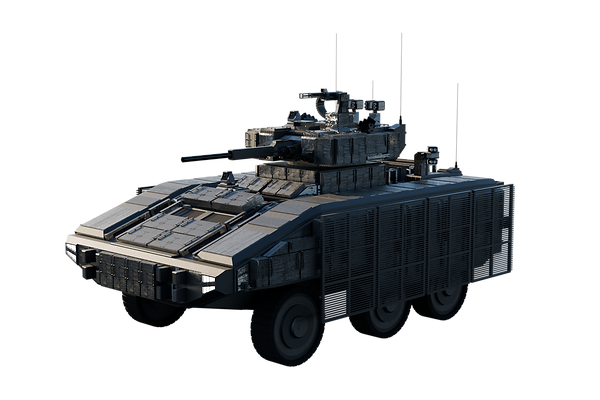
|| FACTION: Unified Terran Nations Planetary Forces
|| TYPE: Armoured Fighting Vehicle
|| ROLE: IFV/APC
|| CREW: 3
|| TROOP CAPACITY: 20 (R37), 12 (F100)
|| DATE INTRODUCED: 2610 A.D
|| STATUS: In use by mutliple irregular forces
|| NO. BUILT: > 10,000
||VARIANTS: R37 APC, F100 IFV
||MASS: 85 T
||HEIGHT: 6 M (R37), 7.2 M (F100)
||LENGTH: 12.5 M
||WIDTH: 7.7 M
||PROPULSION: Rockal Nuclear Dynamics (RND) Dual-Cylinder RF-2/18B Fusion Turbine driving 6x 1.3 MW Electric Traction Motors
||POWERPLANT: RF-2/18B Fusion Turbine (16 MW)
||SUSPENSION: Dynamic Fluid Hydraulic
||TRANSMISSION: Traction Motor per wheel, dynamic differential
||MAX SPEED: 150 KM/h
||FUEL CAPACITY: 1200 L
||ARMOUR: Macropolymer-based Composite Arrays
||ARMAMENT: F100: 100mm FIMD-100 Medium/Low Velocity Cannon mounted in unmanned turret. Co-axially mounted HMG-20 Machinegun. Remote operated HMG-20 Machinegun in Weapon Station on top of primary turret.
R37: 37mm FIMD-37 Autocannon mounted in a Remote Weapon Station with 3X MPLAT Light ATGM Launchers.
The Armoured Fighting Vehicle, 6-wheeled, or AFV-6, is a large, all-terrain ground-contact traction armoured vehicle designed by the Unified Terran Nations’ Planetary Forces for use with Marine and Army mechanised infantry units. The vehicle is effectively a mid-point between the lighter AFV-4 ‘Coyote’ Patrol vehicles and the heavier AFV-8 ‘Titan’ wheeled MBTs. While the AFV-8 series included a heavier Infantry Fighting Vehicle / Personnel Carrier based on the 8-wheeled design, it proved too heavy and large for most urban deployments; especially highlighted during civil unrest or insurgency deployments where AFV-8s could not operate effectively, and AFV-4s often lacked the protection required for IFV roles.
The AFV-6 concept was first designed by the PF Ground Vehicle Design Bureau in 2607 A.D; mass production of this design was initiated by 2610 A.D. By 2612 A.D, most regiments of mechanised infantry in the Federal Expeditionary Branch of the Planetary Forces were equipped with AFV-6s in at least one Company consisting of four platoons of up to six vehicles; essentially the same deployment as the larger AFV-8.
The AFV-6 was well received by crews and infantry using it, during urban deployments, infantry praised the more specious interior and better suspension than the 4-wheeled Coyotes they used where larger AFV-8 units could not effectively operate before. The AFV-6’s heavier armour also proved valuable during insurgency operations, while its smaller size and weight allowed it to operate in the densely packed prefabbed habitation streets of most human planetary cities of the 3rd millenium.
Like most Vehicles designed by the UTN (and later, the UAS and eventually ATIS) the AFV-6 is a modular platform with support for extensive modifications both in-field and during refits. Two distinct variants of the AFV-6 were used by the FEPF and PG units of the UTN: AFV-6/R37 and AFV-6/F100. The former uses the PF’s standardised 37-mm FIMD autocannon equipped Remote Weapons Station and is optimised for use as a personnel carrier due to the smaller internal requirements of the RWS.
The second is the F100 variant which is equipped with a specialised, larger turret using the same medium/low velocity 100mm FIMD cannon as used on the Coyote AFV-4/F100. The larger turret allows a more robust and faster autoloading system and the incorporation of a co-axial HMG-20 20mm Heavy Machine Gun, with a second mounted to a RWS atop the turret. This variant was specialised for use as an Infantry Fighting Vehicle. Although the unmanned turret included the ‘ready rack’ magazine internally, most units of this type carried additional ammunition in the hull for extended deployments, thus reducing the number of troops that could be carried internally.
